By Timilehin Agunbiade
There are bridges, and then there are these bridges that are just spectacularly built differently.
These bridges demonstrate remarkable engineering and design making them some of the most unusual and eye-catching structures in the world.
Most of them are man made, but we see an entirely different level of engineering in the case of some, whereby nature tends to the heart desire of men, hence, birthing a living structure – not trying to be a spoiler, but do watch out for this particular one.
5. Rolling Bridge, London, United Kingdom

Designed by British designer and artist Thomas Heatherwick, this pedestrian bridge at London’s Paddington Basin can curl up into an octagonal shape to allow boats to pass through, then fully unfurl to create a unique and practical crossing.
The Rolling Bridge operates using a hydraulic system hidden beneath the walkway. When activated, the hydraulic pistons cause the individual sections of the bridge to curl and form a circular shape.
It essentially rolls itself up and out of the way.
Pistons are cylindrical rods or shafts that move back and forth or up and down within a cylinder, they play a crucial role in transforming pressure into mechanical energy, which powers a machine or engine.
The Rolling Bridge is not just a functional structure but also a work of art. Its design and movement are intended to blend art and engineering, making it an iconic landmark in London.
4. Banpo Bridge Rainbow Fountain, Seoul, South Korea

The world’s longest bridge fountain, with thousands of LED nozzles that create a mesmerizing water and light show, adding a touch of enchantment to the cityscape.
The bridge is equipped with a water purification system that extracts water from the river, purifies it, and then releases it in a cascading waterfall effect as part of the Moonlight Rainbow Fountain display.
The Banpo Bridge has become a popular tourist attraction and a symbol of Seoul. Visitors and locals alike enjoy the bridge’s mesmerizing light shows and the scenic views it offers.
3. Langkawi Sky Bridge, Malaysia
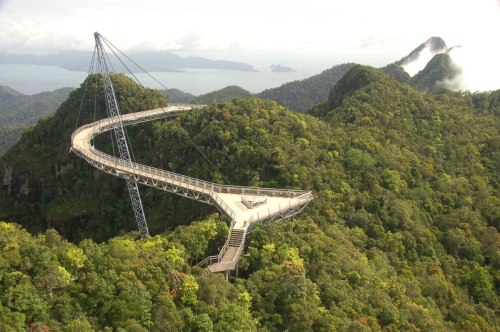
Suspended high above the mountains, this curved pedestrian bridge offers stunning scenic views of the surrounding lush rainforest, mountains, and the Andaman Sea.
The bridge is a pedestrian suspension bridge that extends for approximately 125 meters (410 feet) and is suspended at a height of about 700 meters (2,300 feet) above sea level.
It is supported by a single pylon and curved in an arch-like shape, creating a unique visual experience.
The Langkawi Sky Bridge’s suspension system is designed to allow some degree of movement and swaying, which adds to the thrill of walking on the bridge.
The bridge is one of Langkawi’s most popular tourist destinations, drawing visitors from around the world who are eager to experience its unique and awe-inspiring setting.
2. Lucky Knot Bridge, Changsha, China

Inspired by the Chinese knot, this steel pedestrian bridge twists and loops to form a unique and visually striking structure over the Dragon King Harbor River.
The Lucky Knot Bridge was designed by NEXT Architects, a Dutch architecture firm. The design concept draws inspiration from traditional Chinese decorative knots, which are considered symbols of luck and prosperity.
The bridge’s twisting and looping structure is meant to resemble a lucky knot.
The bridge features three pedestrian walkways that intertwine and spiral around one another. This complex and aesthetically striking design is intended to provide different viewpoints and experiences for pedestrians.
The bridge is constructed primarily from weathering steel, which gives it a reddish-brown color that complements the surroundings. The steel is both durable and low-maintenance.
The Lucky Knot Bridge has become a prominent tourist attraction, drawing visitors who are interested in its unique architecture, the picturesque views it offers, and its cultural significance.
1. Living Root Bridges, Meghalaya India
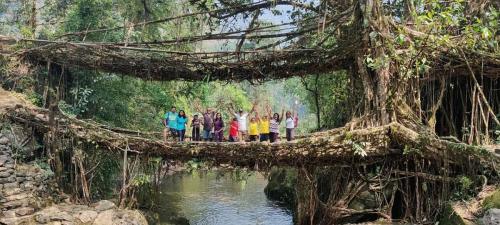
In Cherrapunji, locals train the roots of Ficus elastica trees to grow across rivers, creating natural, living bridges that become stronger with time.
The Khasi and Jaintia tribes of Meghalaya have been practicing the art of growing living root bridges for generations.
These bridges are crafted by guiding the roots of rubber trees across streams and rivers to create a living, resilient bridge.
The living root bridges are made from natural materials and are environmentally sustainable. They are considered “green” infrastructure, as they do not require the felling of trees or the use of conventional building materials.
Over time, the roots of the rubber trees grow stronger and thicker, enhancing the structural integrity of the bridge.
Some living root bridges are estimated to be over 100 years old and can support the weight of many people at once.
These bridges are in harmony with the natural environment. The living roots continue to grow and adapt, allowing the bridge to self-repair and regenerate over time.
Many of the living root bridges are located in remote and hilly areas of Meghalaya, where they provide essential access to otherwise isolated villages and communities.
ALSO READ: Bobrisky announces another December surgery for further transformation
The living root bridges have gained international attention and have become popular tourist attractions. Visitors are drawn to their unique and sustainable construction.
 AGS NEWS