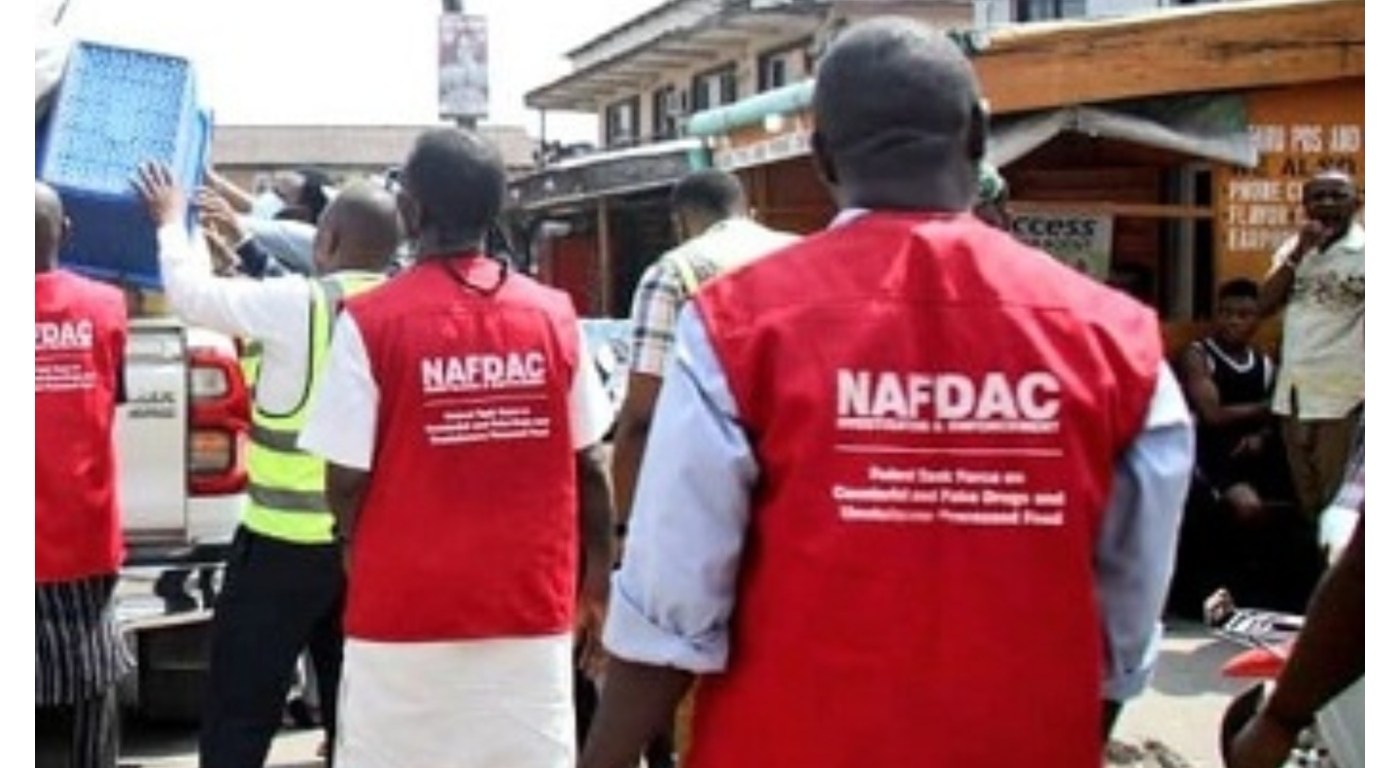
In a major operation that has sparked national security concerns, the National Agency for Food and Drug Administration and Control (NAFDAC) has uncovered and sealed a warehouse in Kano State containing a staggering volume of industrial chemicals believed to be capable of producing explosives.
The discovery was made at a facility located in Kwakwachi, within Fagge Local Government Area, where officials found 88,560 litres of hazardous substances, including 60,000 litres of sulphuric acid (90.5% concentration) and 28,560 litres of nitric acid (68% concentration). Both are highly restricted chemicals known to be precursors in the manufacture of explosives.
During an inspection of the site on Wednesday, NAFDAC’s Director-General, Prof. Mojisola Adeyeye, described the discovery as “deeply alarming.” She was represented at the scene by Dr. Martins Iluyomade, the agency’s Director of Investigation and Enforcement.
“What we have seen here is mind-boggling,” Prof. Adeyeye stated. “I don’t think I have ever seen this quantity of concentrated nitric and sulphuric acid together in one place like this before.”
Also recovered from the warehouse were 330 empty jerricans, indicating that portions of the chemicals had already been distributed—raising further concerns over their final destination.
The operation followed an intelligence tip-off that led NAFDAC officials to the location. At the time of the raid, only a warehouse manager was present. He was immediately arrested and taken into custody for questioning.
ALSO READ: NAFDAC to reevaluate sanctions for substandard product exporters
Investigations revealed that the facility’s listed owner is not a licensed chemical marketer, a violation of regulatory guidelines governing the handling of such substances.
“The owner is not registered in our chemical marketing database,” Adeyeye said. “Importing and handling these substances require stringent security clearance and federal permits—none of which were available in this case.”
She stressed that chemicals of this nature are classified as controlled substances due to their potential use in producing explosives. Importation or possession without proper authorization is illegal and poses a significant threat to public safety.
“The volume of what we found here,” she warned, “is enough to destroy the whole of Kano if mishandled.”
NAFDAC has since launched a full-scale investigation to identify the individuals behind the operation and determine the intended use of the chemicals. Interrogations of the detained warehouse manager are underway, and efforts to apprehend the primary suspect—believed to be the owner—are ongoing.
Prof. Adeyeye assured the public that the seized chemicals will be safely destroyed in accordance with environmental and safety regulations to prevent any possible misuse.
“This is a serious breach of our national security and safety protocols,” she said. “NAFDAC will not relent in tracking down those responsible.”
The agency has urged citizens to remain vigilant and report any suspicious industrial activity involving hazardous substances.
 AGS NEWS