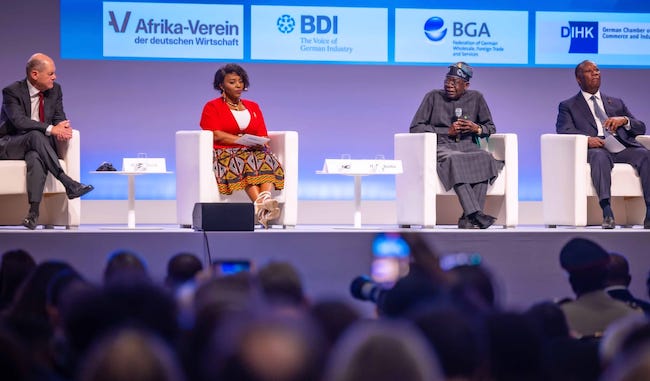
Nigerian and German companies have formalized two crucial agreements in Berlin, signaling a major boost to economic ties.
Valued at $500 million, the agreements involve a renewable energy pact and a gas export deal, representing a significant milestone in bilateral cooperation, as stated by Presidential spokesperson Ajuri Ngelale.
Union Bank of Nigeria and Germany’s DWS Group have solidified a Memorandum of Understanding (MoU) on renewable energy.
ALSO READ: Nigerians are our biggest strength in global investments – Tinubu
The strategic partnership aims to attract $500 million in investments dedicated to renewable energy projects, focusing primarily on rural communities across Nigeria.
The second MoU establishes a gas export partnership between Riverside LNG of Nigeria and Germany’s Johannes Schuetze Energy Import AG.
Nigeria commits to supplying 850,000 tons of natural gas annually to Germany, with projections indicating an increase to 1.2 million tons.
The initial shipments are scheduled for 2026, with a crucial aspect of the deal contributing to processing approximately 50 million cubic feet per day of natural gas that would otherwise be flared.
This agreement aligns with both nations’ commitment to environmentally conscious practices and sustainable energy solutions.
ALSO READ: FG unveils $23 billion investment opportunities in energy transition plan
Nigeria, home to Africa’s largest gas reserves exceeding 200 trillion cubic feet, has faced environmental concerns linked to gas flaring.
The deal represents a crucial step toward addressing this issue and harnessing Nigeria’s abundant gas resources for sustainable energy projects.
President Bola Tinubu, attending the G20 Compact with Africa conference in Berlin, expressed his approval of the agreements.
This positive sentiment aligns with Germany’s commitment to investing 4 billion euros in green energy projects in Africa by 2030, as announced by Chancellor Olaf Scholz.
The collaborative effort aims to support Germany’s transition to carbon neutrality and meet its goal of net-zero emissions by 2045.
ALSO READ: Germany hastens troop withdrawal from Mali as UN mission concludes
During a German-African business forum preceding the G20 Compact with Africa summit, Scholz emphasized the pivotal role these investments play in achieving environmental objectives, particularly the need for green hydrogen imports from Africa.
Under President Tinubu’s leadership, Nigeria has implemented significant reforms, including the removal of a popular petrol subsidy and the relaxation of foreign exchange trading restrictions.
These initiatives aim to make Nigeria more attractive to investors and revitalize its economy, addressing challenges such as sluggish growth, record debt, double-digit inflation, and crude oil theft.
The Federal Government recently disclosed that more than N4.3 trillion worth of crude oil was stolen in 7,143 pipeline vandalism cases within five years.
Oil theft poses a serious threat to oil exploration and exploitation with significant negative consequences on economic growth, business prospects, and profit earnings by oil companies,
 AGS NEWS