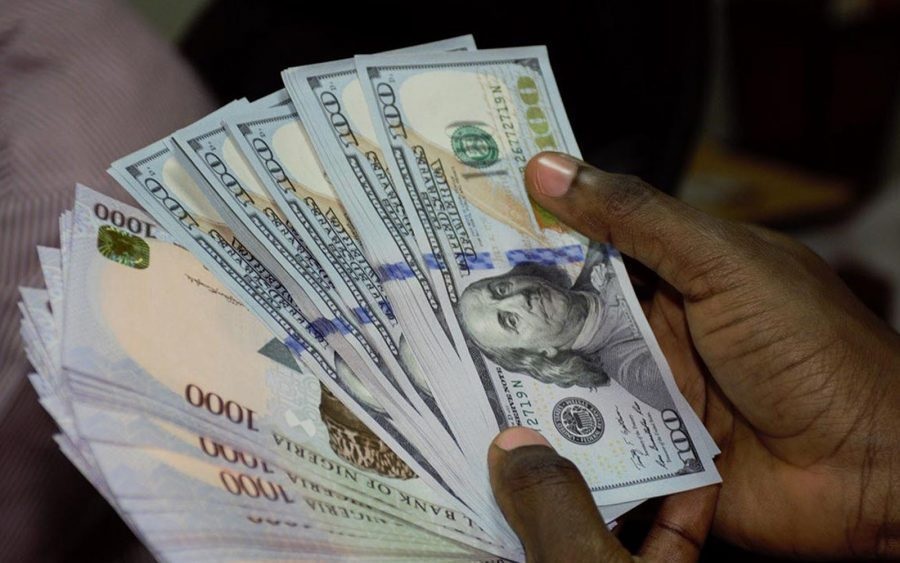
The ongoing instability of the Naira in relation to the US dollar has been causing waves of uncertainty in Nigeria’s economy, leading to concerns among investors.
Last week, there was a temporary relief as the country’s currency gained strength against the dollar, reaching an exchange rate of N970/$1 in the parallel market, a significant improvement from the N1300/$1 rate recorded the previous week.
However, the Naira’s performance took a hit at the beginning of this week, with exchange rates fluctuating between N1000 and N1020/$1 on Monday.
ALSO READ: Traders express concern over mentally ill individuals in Ogun
This represents a slight depreciation from the weekend’s rate of N970/$1.
Similarly, the official FMDQ market observed a minor depreciation of the Naira by 4.24 percent, with the exchange rate falling to N809.02/$1 from N780.03/$1 on the preceding Friday.
Meanwhile, Nigeria’s Foreign Exchange Reserves saw an increase to $33,340 million in October, up from $33,240 million in September 2023.
The Naira has been experiencing fluctuations since the Central Bank of Nigeria introduced a flexible exchange rate system in the forex market on June 14, raising concerns within various industries.
Kalu Aja, a financial expert, shared his perspective during an interview with Channels Television, suggesting that achieving stability for the Naira seems elusive.
He remarked, “The strength of the Naira is solely tied to crude oil sales. Unless there is a substantial increase in crude oil exports, the currency will remain unstable.”
ALSO READ: Edo state partners with palm oil company to boost production
This viewpoint coincided with Nigeria’s earnings of N5.14 trillion from crude oil sales in the first three months of 2023, a rise from N4.9 trillion in the previous quarter, as reported by the National Bureau of Statistics.
Prof Segun Ajibola, a renowned economist and former President and Chairman of the Council of Chartered Institute of Bankers, pointed out that the current forex market trend reflects a currency struggling to find its fair value.
To ensure the Naira’s sustainable strength, he stressed the need for the Central Bank of Nigeria and the federal government to address supply challenges in foreign exchange consistently.
He stated, “Sustainable efforts must be implemented to address supply rigidities.
Otherwise, the unstable global oil market will continue to dictate the happenings in Nigeria’s forex market, resulting in significant exchange rate fluctuations.”
Prof Godwin Oyedokun, a don at the Lead City University in Ibadan, outlined seven action points the government should consider to address the Naira’s instability in the forex market.
These points include implementing sound monetary policies, enhancing foreign exchange reserves, promoting export diversification, controlling inflation, strengthening local industries, enhancing transparency and accountability, and strengthening investor confidence.
He emphasized that addressing the Naira’s volatility is a complex challenge requiring a comprehensive solution, and these suggestions provide a starting point to tackle the issue.
ALSO READ: Dangote and BUA point fingers in dispute over forex probe allegations
Mr. Idakolo Gbolade, the CEO of SD & D Capital Management, called for increased forex supply in the market to stabilize the Naira.
He highlighted the importance of having sufficient forex reserves to intervene effectively and address backlogs and new requests, particularly in the context of fluctuations in crude oil revenue, a significant revenue source for the country.
 AGS NEWS