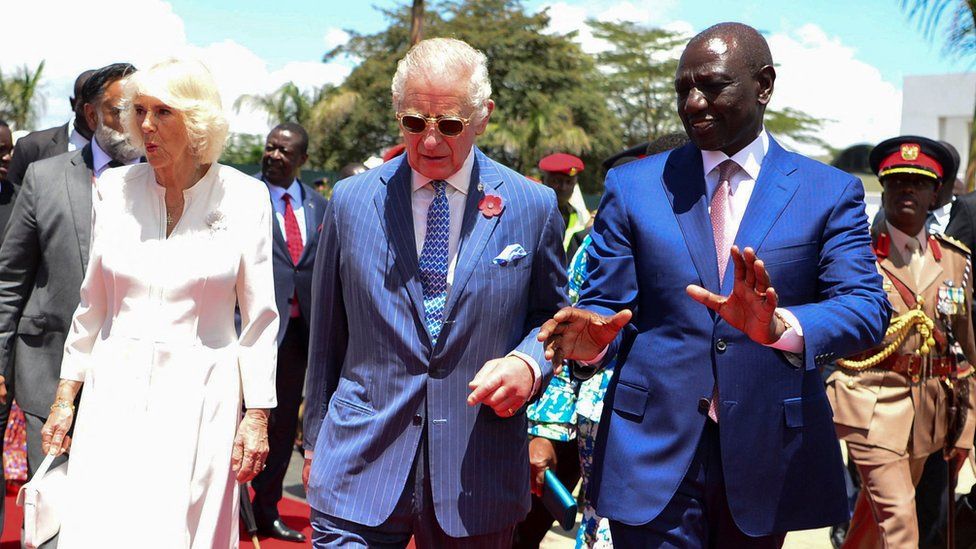
During the second day of his state visit to Kenya, King Charles III expressed remorse for the colonial-era abuses that occurred under British rule in the country.
He acknowledged there was “no excuse” for the atrocities that took place during Britain’s domination of Kenya, which led to its hard-fought independence in 1963.
While widespread calls for a formal apology continue, King Charles stated that he wished to deepen his understanding of these wrongs and strive for a modern partnership between the UK and Kenya.
His visit with Queen Camilla aims to strengthen a “partnership of equals facing today’s challenges.”
On the first day of his visit, King Charles mentioned that the past wrongdoings were a source of deep regret and sorrow but stopped short of issuing a formal apology.
He conveyed his acknowledgment of “abhorrent and unjustifiable acts of violence committed against Kenyans as they waged… a painful struggle for independence and sovereignty.”
King Charles has previously visited Kenya three times, but this marks his first official tour of an African and Commonwealth nation since ascending to the throne last year following Queen Elizabeth II’s death.
The Kenyan press responded to the visit, with headlines like “Facing the Empire’s dark past” and calls for reparations deemed “unrealistic.”
However, there are suggestions that the monarch could facilitate the return of historical artifacts, including the skull of a tribal leader who led a resistance movement against colonial rule over a century ago.
During their visit, King Charles and Queen Camilla received a ceremonial welcome from President William Ruto, where they laid a wreath at the Tomb of the Unknown Warrior in the Uhuru Gardens Memorial Park.
This location holds historical significance as it is where Kenya’s independence was declared in 1963, but it was also the site of a British colonial camp where Mau Mau guerrillas were detained during their 1952-1960 uprising.
The period, known as the “Emergency,” was one of the bloodiest insurgencies of the British Empire, resulting in thousands of deaths and inhumane treatment of detainees.
ALSO READ: Kenyan president William Ruto lands in China for belt and road forum
President Ruto commended King Charles for his courage and readiness to confront these uncomfortable truths.
The royal visit to Kenya holds special meaning for the royal family, particularly Queen Elizabeth II, who learned of her father’s death in Kenya in 1952, marking the beginning of her 70-year reign.
In the following days of the visit to Nairobi and Mombasa, King Charles will engage in various activities, focusing on climate change, support for the arts, technology, and youth development.
 AGS NEWS