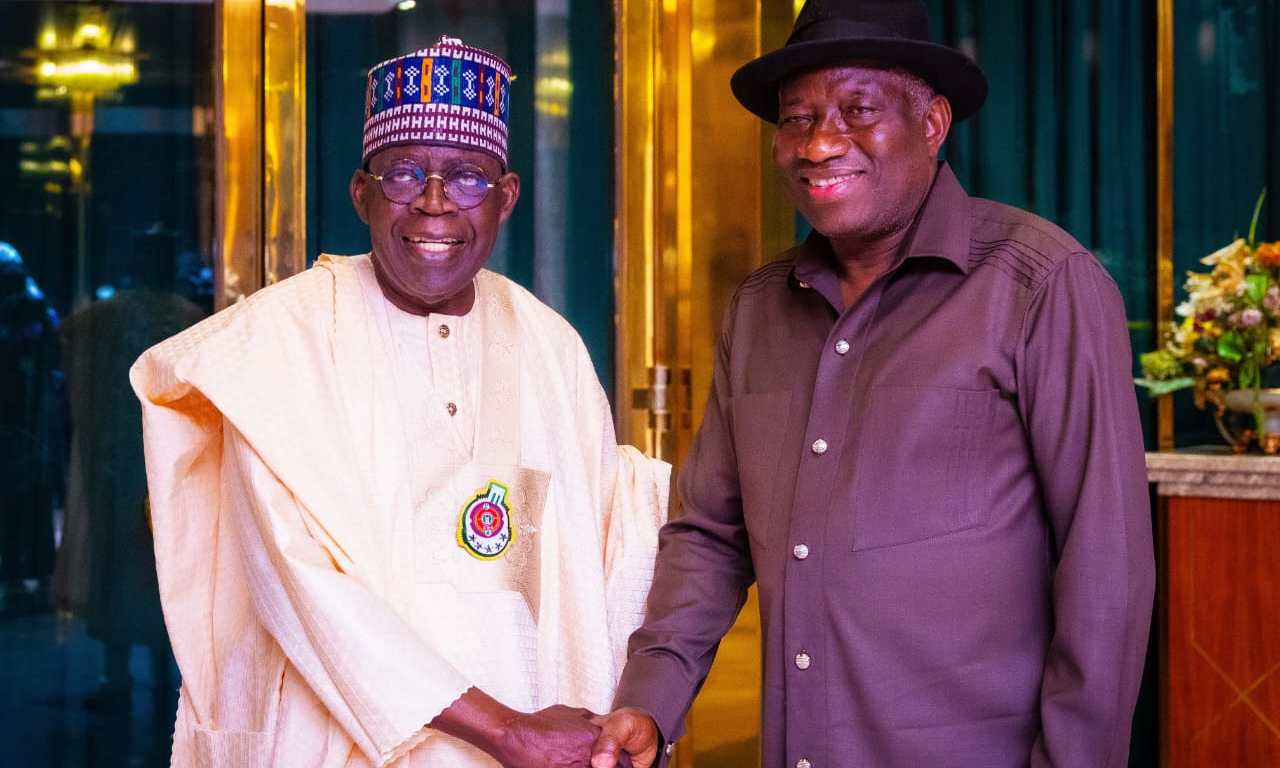
Former President Goodluck Jonathan expressed his belief that Nigeria’s recent peaceful transition of power positions the country to continue leading Africa’s democratic front.
He emphasized that now that the elections are over, leaders, both past and present, as well as the electorate, must work together to shape a better future for the nation.
Speaking to State House Correspondents after a meeting with President Bola Tinubu at the Aso Rock Villa, Abuja, Jonathan stressed the importance of moving forward despite the prevailing economic challenges.
ALSO READ: Goodluck Jonathan calls for increased government investment in science and technology
He commended the recent Supreme Court verdict that affirmed President Tinubu’s victory in the February polls.
Jonathan has been actively involved in peace and diplomacy efforts across Africa, particularly in West Africa, and plans to visit Kenya and Liberia soon to continue his regional dialogues aimed at promoting peace in the sub-region and the entire continent.
ALSO READ: Tinubu emerges winner after 171 day legal battle
During his discussion with President Tinubu, Jonathan indicated that the focus was on the nation’s progress and the potential leadership role Nigeria could play in Africa. He emphasized the importance of regular consultations with the current President, especially concerning foreign programs, and noted that such consultations are part of a long-standing tradition among former Presidents.
ALSO READ: Igboho accuses Gumi of selfish motives in criticizing Tinubu’s appointments
Jonathan’s visits to the State House are intended to advance Nigeria’s interests, as well as those of the Economic Community of West African States and the entire African continent. He remains a Special Envoy of ECOWAS and leads mediation talks in Mali, which has been under military rule since the August 2020 coup that ousted President Ibrahim Keita.
Mali’s military government recently announced a slight delay in the presidential election scheduled for February 2024 due to technical reasons, including the adoption of a new constitution, a review of electoral lists, and a dispute with the French company Idemia involved in the census process.
The Economic Community of West African States had imposed sanctions on Mali in January 2022 when the junta led by Asimi Goita sought to stay in power for up to five years.
Under pressure from the regional bloc, the junta promised to hold the election in February, leading to the lifting of trade and financial sanctions on Mali in July 2022.
 AGS NEWS