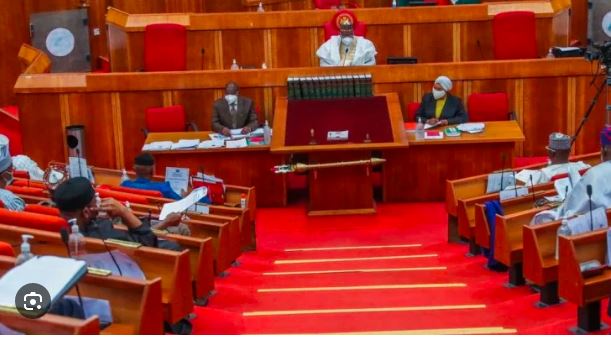
The Senate of Nigeria has issued a plea to the Federal Government, urging it to declare a state of emergency to address the escalating crisis of drugs and narcotics abuse within the country.
This critical decision was reached during the Senate’s plenary session while deliberating on a motion titled “Immediate Intervention Required to Combat Drug Abuse in Nigeria,” introduced by Senator Babangida Uba Hussaini.
The National Bureau of Statistics (NBS) recently reported that the consumer price index (CPI), which measures the rate of change in prices of goods and services, rose to 26.72 percent in September 2023, marking the ninth consecutive increase in the nation’s inflation rate this year.
Senate President Godswill Akpabio expressed deep concern regarding the drug abuse crisis, highlighting the extent to which young individuals have resorted to inhaling vapors for a high, even going as far as drilling holes in soakaway pits.
He urged parents to regularly inspect soakaways to ensure their integrity.
Deputy Senate President Jibrin Barau emphasized the importance of youth to a nation’s future and the detrimental impact on the nation when its youth are adversely affected.
He pointed out that drug abuse is pervasive across various segments of society, affecting not only the general population but also celebrities and politicians.
While commending the efforts of the National Drug Law Enforcement Agency (NDLEA), Barau called for increased vigilance from all stakeholders responsible for addressing this critical issue.
ALSO READ: FG to re-engage retired medical practitioners to address brain drain – Health minister
He noted that the country’s future hinges on its youth, and the destructive consequences of drug abuse must be addressed urgently.
Senator Babangida Uba Hussaini, in his lead argument, shed light on the significant surge in drug abuse in Nigeria. He underscored the urgency of the situation and cited a report from the United Nations Office on Drugs and Crime and the European Union, which revealed that approximately 14.3 million Nigerians between the ages of 15 and 64 are engaged in drug abuse.
Hussaini also provided a breakdown of drug usage across various geopolitical zones, illustrating the extent of the problem.
He further noted that the main drugs abused in Nigeria include mood-altering or psychoactive drugs, performance-enhancing drugs, dependency drugs, and prescription drugs, all of which have adverse side effects.
 AGS NEWS