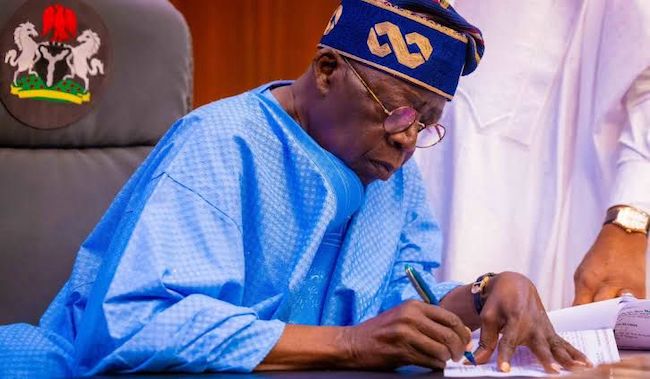
The total spending by the Federal Government on palliatives and loans to cushion the effect of the fuel subsidy removal may hit N3.27tn.
The palliatives and loans were meant to cushion the effects of economic hardships on Nigerians and businesses following the removal of fuel subsidies and skyrocketing consumer prices due to high inflation.
These palliatives included N100bn to acquire 3,000 units of 20-seater CNG-fuelled buses, N200bn to boost agriculture production, N75bn for manufacturers, N125bn for micro, small and medium-sized enterprises and the informal sector, N185bn as palliatives for states, N1tn on student loans and other programmes.
Others included N315bn to pay federal workers’ N35,000 allowance for six months, N1.13tn to 15 million households at N25,000 per month for three months from October to December 2023, N70bn earmarked as palliative measures for lawmakers, and N75bn loan facility to 1.5m market women.
President Bola Tinubu’s announcement that “subsidy is gone” on May 29, 2023, shook the economy as the price of fuel had more than doubled since then. This led to a surge in the price of commodities and a spike in inflation.
Following this removal, the World Bank announced that 7.1 million Nigerians were at risk of poverty if the Federal Government failed to compensate or provide palliatives for them.
This would have increased the number of poor Nigerians to 100.9 million, according to the bank. The bank said, “In the immediate term, the removal of the petrol subsidy has caused an increase in prices, adversely affecting poor and economically insecure Nigerian households. Petrol prices appear to have almost tripled following the subsidy removal.
“The poor and economically insecure households, who directly purchase and use petrol as well as those that indirectly consume petrol, are adversely affected by the price increase.
Among the poor and economically insecure, 38 per cent own a motorcycle and 23 per cent own a generator that depends on petrol. Many more use petrol-dependent transportation.
“The poor and economically insecure households will face an equivalent income loss of N5,700 per month, and without compensation, an additional 7.1 million people will be pushed into poverty.”
Responding to this, the Federal Government began to announce support through loans and palliatives to Nigerians. In a national broadcast on July 31, the president announced the first sets of palliatives.
He revealed a N500bn palliative plan that included N100bn to acquire 3,000 units of 20-seater CNG-fuelled buses, N200bn to boost agriculture production, N75bn for manufacturers, and N125bn for micro, small and medium-sized enterprises, and the informal sector.
This move, he said, would tone down the agony of Nigerians from the pains of fuel subsidy removal. Commenting on the agricultural scheme, the President said, “Our plan to support cultivation of 500,000 hectares of farmland and all-year-round farming practice remains on course.
“To be specific, N200bn out of the N500bn approved by the National Assembly will be disbursed as follows: Our administration will invest N50bn each to cultivate 150,000 hectares of rice and maize. N50bn each will also be earmarked to cultivate 100,000 hectares of wheat and cassava.”
To cushion the effect of subsidy on states, the Federal Government announced N5bn as palliative measures for each state of the federation and 180 trucks of rice.
According to the Borno State Governor, Babagana Zulum, the N5bn would enable the state governments to procure 100,000 bags of rice, 40,000 bags of maize, and fertilisers to cushion the food shortage in the country.
ALSO READ: Federal government requests Google’s removal of 18 loan apps from play store
He noted that 52 per cent of the money would be in the form of grants, while the remaining 48 per cent would be paid back by the states on an instalment basis within 20 months to the Central Bank of Nigeria.
Announcing the other palliatives, Tinubu stated that N75bn (to be disbursed between July 2023 and March 2024) will be given to 75 manufacturing enterprises as N1bn credit at nine per cent per annum. N125bn was earmarked for micro, small and medium-sized enterprises and the informal sector.
Out of the sum, the government would spend N50bn on conditional grants to one million nano businesses.
Highlighting how the government intended to spend N1tn on student loans and other programmes, the President said, “In a little over two months, we have saved over a trillion naira that would have been squandered on the unproductive fuel subsidy which only benefitted smugglers and fraudsters.
“That money will now be used more directly and beneficially for you and your families.
“For example, we shall fulfil our promise to make education more affordable to all and provide loans to higher education students who may need them.
No Nigerian student will have to abandon his or her education because of lack of money.”
After numerous strike threats by organised labour, the Federal Government eventually agreed to spend N315bn to pay federal workers and N35,000 allowance, increasing its palliatives bill.
A statement by the Minister of Information and National Orientation, Mohammed Idris, said, “The Federal Government has announced N35,000 only as a provisional wage award for all treasury-paid Federal Government workers for six months following further consultation with President Bola Tinubu.”
Recently, the Director-General of the Budget Office of the Federation, Ben Akabueze, revealed that the Federal Government’s personnel cost was over N5tn, with
 AGS NEWS