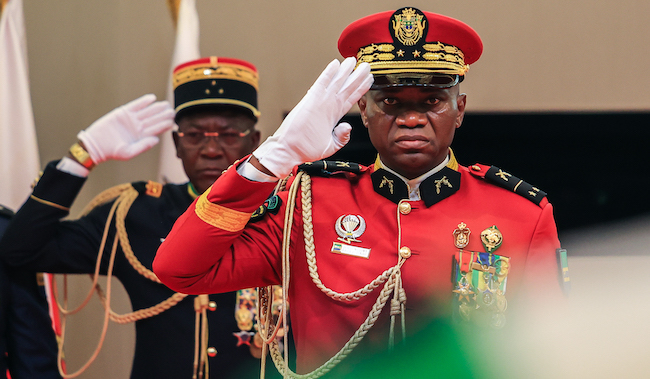
Brice Oligui Nguema, the Gabonese General who orchestrated a coup last week, putting an end to the 55-year reign of the Bongo dynasty, was officially inaugurated as interim president on Monday, as reported by AFP journalists who witnessed the ceremony.
Oligui, previously the head of the elite Republican Guard, had led a group of officers in the coup against President Ali Bongo Ondimba, whose family had been in power since 1967.
ALSO READ: Gabon opposition urges international pressure on junta to transfer power to civilians
The coup unfolded shortly after Bongo’s victory in the previous month’s presidential election was declared, a result contested by the opposition, labeling it as fraudulent.
During the swearing-in ceremony, Oligui, dressed in the red ceremonial attire of the Republican Guard, pledged to “faithfully preserve the republican regime” and to uphold the achievements of democracy.
He also promised to organize “free… (and) transparent elections” following an unspecified transition period and to grant amnesty to “prisoners of conscience.”
In the wake of the coup, the new leadership had declared the dissolution of the country’s institutions, annulled the election results, and temporarily closed the borders.
However, international recognition of Oligui as Gabon’s legitimate leader has been lacking, and he faces mounting pressure to outline his plans for restoring civilian governance.
Oligui has engaged in extensive consultations with various stakeholders, including business leaders, religious figures, labor unions, political parties, NGOs, diplomats, and journalists, responding thoughtfully to questions and grievances.
While some in the former opposition have called for him to relinquish power, many Gabonese citizens have welcomed the overthrow of the Bongo dynasty, celebrating in the streets of the capital, Libreville, and the economic center, Port-Gentil.
Several Western nations and organizations have condemned the coup while acknowledging its uniqueness due to concerns about the credibility of the preceding election.
The European Union’s foreign policy chief, Josep Borrell, noted, “Naturally, military coups are not the solution, but we must not forget that in Gabon there had been elections full of irregularities.”
Former President Ali Bongo, who had sought a third term, was reportedly placed under house arrest and “in retirement” by the coup leaders.
Nevertheless, he managed to release a video on social media claiming that his son and wife, Sylvia, were detained and appealing for international support.
National television subsequently aired footage of Noureddin Bongo Valentin, the deposed president’s son, and other arrested officials alongside suitcases allegedly filled with seized cash.
They face charges of treason, embezzlement, corruption, and forging the president’s signature, among other allegations.
ALSO READ: AU suspends Gabon after military coup
This coup in Gabon joins a series of recent coups in Africa, including those in Mali, Guinea, Sudan, Burkina Faso, and Niger over the past three years.
The new leaderships in these countries have been met with calls for a swift return to civilian rule, but progress has been limited in that regard.
 AGS NEWS