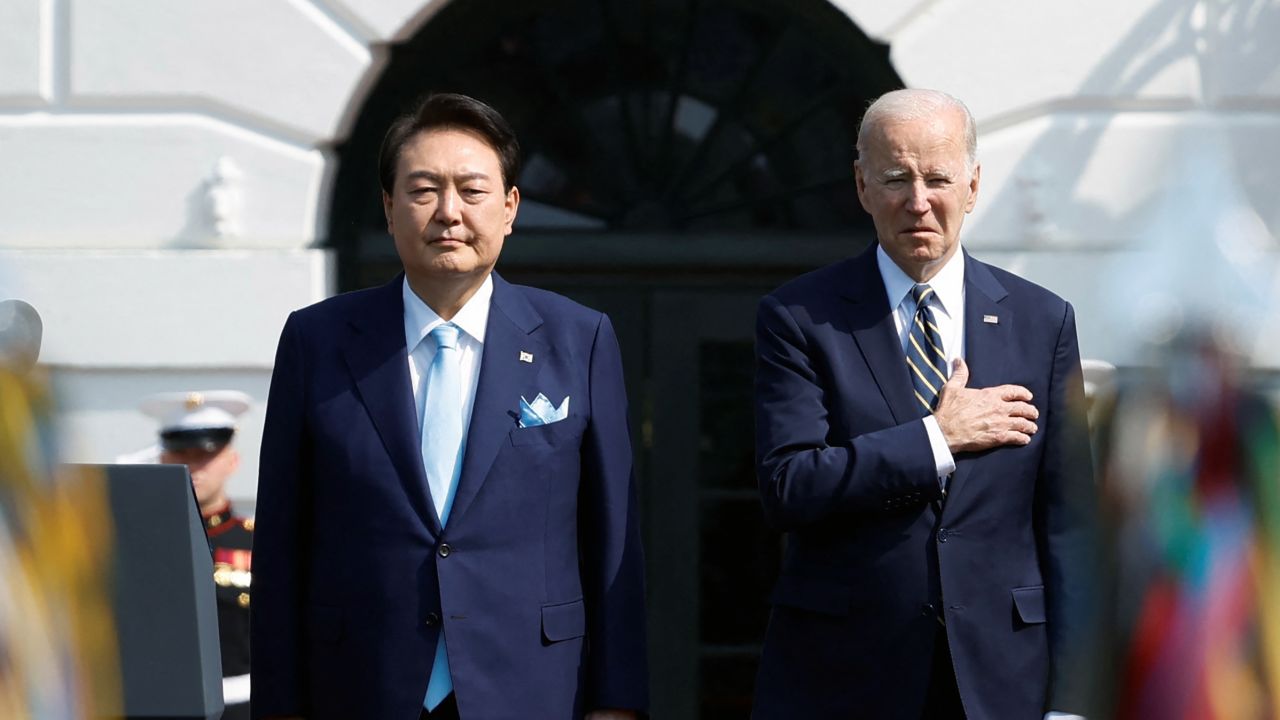
The US and South Korea have reached a landmark agreement to counter the North Korean nuclear threat. The Washington Declaration involves periodic deployment of US nuclear-armed submarines to South Korea and Seoul’s involvement in US nuclear planning operations.
In return, South Korea has agreed not to develop its own nuclear weapons. US President Joe Biden has said that the agreement would strengthen the allies’ cooperation in deterring a North Korean attack. The fear of the nuclear threat posed by North Korea has been rising on both sides.
Pyongyang is developing tactical nuclear weapons that can target South Korea and refining its long-range weapons that can reach the US mainland.
ALSO READ: Recent survey reveals that gun violence has impacted the majority of families in the United States
Under the agreement, the US will make its defense commitments more visible by sending a nuclear-armed submarine to South Korea for the first time in 40 years, along with other strategic assets, including nuclear-capable bombers. The two sides will also develop a Nuclear Consultative Group to discuss nuclear planning issues.
Politicians in Seoul have long been pushing Washington to involve them more in planning for how and when to use nuclear weapons against North Korea.
As North Korea’s nuclear arsenal has grown in size and sophistication, South Koreans have grown wary of being kept in the dark over what would trigger Mr. Biden to push the nuclear button on their behalf. A fear that Washington might abandon Seoul has led to calls for South Korea to develop its own nuclear weapons. But in January, South Korean President Yoon Suk-yeol put this idea back on the table, alarming policymakers in Washington.
ALSO READ: South Korean actress and model Jung Chae-yul, aged 26, found dead in her home
The new Nuclear Consultative Group provides the increased involvement the South Korean government has been asking for. But the bigger question is whether it will quell the public’s anxieties. The US hopes to convince North Korea to give up its nuclear weapons, but last year the North Korean leader Kim Jong Un declared the country’s nuclear status “irreversible”. Some experts say it now makes more sense to discuss arms control rather than denuclearisation.
While the Washington Declaration is a significant step forward in deterring a North Korean attack, it does not ink a total commitment from the US that it would use nuclear weapons to defend South Korea if North Korea were to attack. In return, the US has demanded that South Korea remain a non-nuclear state and a faithful advocate of the non-proliferation of nuclear weapons.
The US sees dissuading South Korea from going nuclear as essential, fearful that if it fails, other countries may follow in its footsteps. However, these US commitments are unlikely to fully satisfy the influential and increasingly vocal group of academics, scientists, and members of South Korea’s ruling party who have been pushing for Seoul to arm itself.
 AGS NEWS